

It is dusk on the cliffs of the Bandiagara Escarpment in central Mali. The drums have started. A man steps out of a hut wearing a wooden mask topped by a tall double cross, with the upper bar reaching toward the sky, and the lower bar pointing to the earth. A long skirt of black-dyed fibres rustles around his legs, and a vest sewn with cowrie shells catches the fading light.
As he begins to dance, his upper body rotates from the hips, and the mask swings in circles around his head. The cross-bars cut through the air as the drumming sharpens, and the crowd watches silently.
What might appear as a performance for the dead is, in fact, a passage. The man inside the costume is no longer himself. He has now become Amma, the creator god of the Dogon. The dance acts as the funeral, and the mask acts as the door, escorting the soul of the deceased out of the village and into the land of the ancestors.
When the ceremony ends, the man will take off the mask and become a man again. The wood will simply be wood again. But for the duration of the dance, something else has been alive in the village, and the village has known it.
What a mask actually is
The first thing to understand about an African mask is that the carved wooden face displayed in a museum is only one part of a much larger performance. The mask gains meaning through the costume, the drumming, the song, the dance, the audience, the season, and the spirit it summons. Take any one of those away and what remains is wood.
A masker does not wear a mask the way a child puts on a Halloween costume. Instead, the dressing takes place in private, often in a sacred space. The entire body is covered so that no part of the person can be seen. Fibre covers the back of the head and the face disappears behind the carved mask, with layers of raffia or cloth hiding the body. The masker may carry rattles, bells, or sometimes a staff, with the drummers and singers accompanying him. By the time he steps out into public, the man inside is no longer seen as an ordinary person. That transformation does not begin with the performance itself. It begins much earlier, with the making of the mask.
Among many West and Central African peoples, the choice of the wood is itself a sacred decision. Some trees are forbidden because they are believed to carry hostile spirits. Others are chosen because their wood is thought to hold the right kind of spiritual presence. Before carving begins, rituals may take place through dreams, sacrifice, prayer, or sometimes a period of silence. Among the Mende of Sierra Leone, for example, a master carver waits until he has the right dream before he carves a Sande mask for a particular initiate. The mask is only considered complete when it is believed to hold spiritual power.
African masquerade is, in this sense, a complete technology. It is a system for accomplishing things that need to be accomplished, for instance, escorting souls, settling disputes, blessing fields, initiating children into adulthood, honouring mothers, or summoning ancestors. The mask becomes an interface between the performer, and the community, allowing the spiritual presence to be expressed through the masquerade.
Six masks, six worlds
1. Kanaga — Dogon, Mali
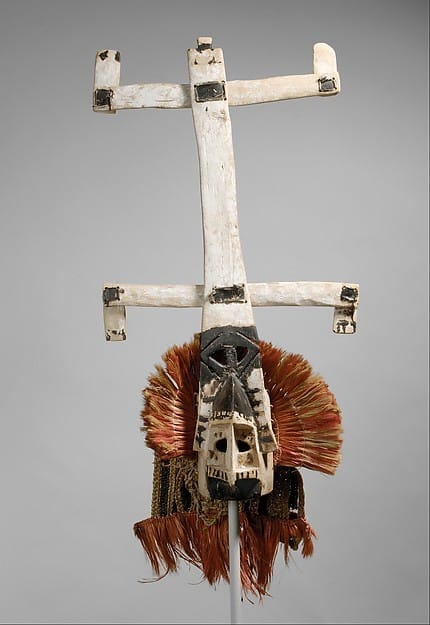
The Kanaga is one of the most recognisable masks in West Africa, and it carries one of the most complete cosmologies. It has a rectangular wooden face with hollowed eye openings and is usually painted in earth tones. Above the face stands a tall double-barred cross like structure made of two horizontal bars stacked vertically, each ending in short upright projections.
The meaning of the cross depends on who you ask, and the Dogon are happy to give multiple answers because all of them are true at once. Some describe it as a bird in flight. Others connect it to Amma, the creator god in Dogon belief, with the upper bar representing his arms, and the lower bar his legs. It can also represent the structure of the universe itself, with the upper bar linked to the sky, the lower one to the earth, and the dancer being the bridge between them.
Kanaga masks appear at Dama, the great Dogon funerary ceremony. Dama is held months or sometimes years after a death, when the family has saved enough to do it properly. The ritual lasts six days and may feature seventy or more masks at once. The Kanaga are the showpieces, and when the dancers rotate their upper bodies and swing the masks in wide arcs, they are imitating Amma, the creator figure in Dogon belief. These movements are associated with creation itself, and the spreading of life force outward. Within Dogon traditions, funerals help guide the spirit of the dead rather than focusing only on mourning.
All Dogon masks belong to a men's society called Awa, which translates simply as Cosmos. The group oversees the rituals and performances connected to the masks and their spiritual role within the community.
2. Sowei — Mende, Sierra Leone
Among the Mende of Sierra Leone, the Sande Society stands apart because it is led by women. In many African masking traditions, masks are worn and controlled by men. Within the Sande, however, women are the maskers and custodians of the masquerade. Related traditions are also found among the Vai, Bassa, and Gola peoples of Liberia, Guinea, and Côte d'Ivoire.
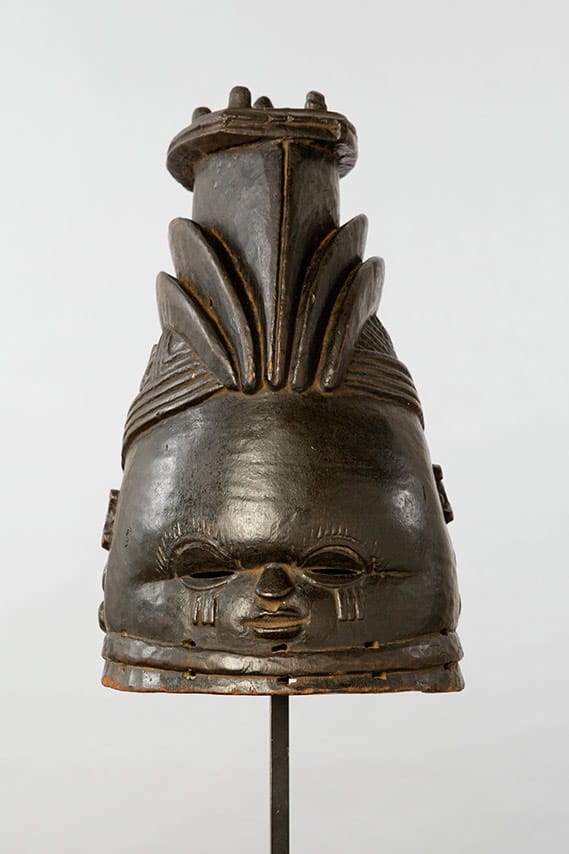
The Sowei is a helmet mask, carved to fit over the entire head and rest on the shoulders. It is finished in deep, lustrous black. The face is small and composed, with a wide forehead, downcast eyes, a tightly closed mouth, and an elaborate hairstyle carved on top. At the base of the neck are two or three concentric rings of flesh.
Different parts of the mask communicate different ideals associated with womanhood and maturity. The wide forehead is linked to wisdom and inner spiritual knowledge. The downcast eyes signify composure, as a Sande woman holds her power inwardly, not outwardly. The neck rings have been read in two ways at once, and both readings are correct. Literally, they are the rolls of healthy flesh that mark a woman ready for childbearing. Symbolically, they are connected to the rippling water from which the Sande spirit is believed to emerge during initiation ceremonies. The blackness of the mask is the rich mud at the bottom of that river, and also the ideal complexion of the woman it honours.
The Sowei appears at the close of the girls' initiation period, when young women emerge from a long seclusion in which they have been taught what it means to be an adult Mende woman. The mask represents the ideals that the Sande Society teaches during initiation. The dancer wearing the mask, known as the ndoli jowei, is a senior Sande official who leads the initiates back into the community at the end of the ceremony.
The Sowei continues to represent one of the most established traditions in West Africa, where women hold central authority within masking.
3. Chiwara — Bambara, Mali
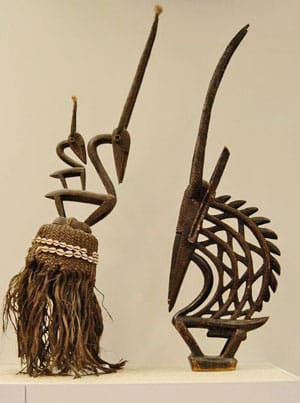
TThe Chiwara is not strictly a face mask. It is a headdress carved in the form of an antelope mounted on a basketry skullcap, worn on top of the dancer's head while a costume of long dyed raffia fibres covers the body to the ground. During performances, the dancer appears like an antelope leaping out of a moving cloud of grass.
Among the Bambara, oral tradition tells of a time before farming, when humans did not yet know how to feed themselves. A being called Chiwara came down to teach them. He was half antelope, half human, born of the union of the earth goddess Mousso Koroni and the spitting cobra N'gorogo. He showed the people how to prepare the soil, plant crops, and harvest food. When the people became careless and wasteful, he buried himself in the earth and disappeared. The Bambara carved the headdresses to remember him.
That story is reflected directly in the form of the headdress itself. The high, swept-back horns are often associated with millet stalks, while the long neck takes the shape of an antelope. The short, low body is linked to the aardvark, an animal that digs into the earth like a farmer. The pierced openwork patterns are connected to the rays of the sun, with some readings connecting them to the movement of the sun across the sky.
Chiwara performances usually involve both male and female dancers. The male leaps and scratches the earth with horns or staff, mimicking the work of cultivation. The female follows behind him, carrying a smaller antelope figure on her back that represents children and future generations. The dance celebrates the best young farmers in the village. Wearing the Chiwara is a sign of respect as one whose hands feed the people.
4. Ngil — Fang, Gabon
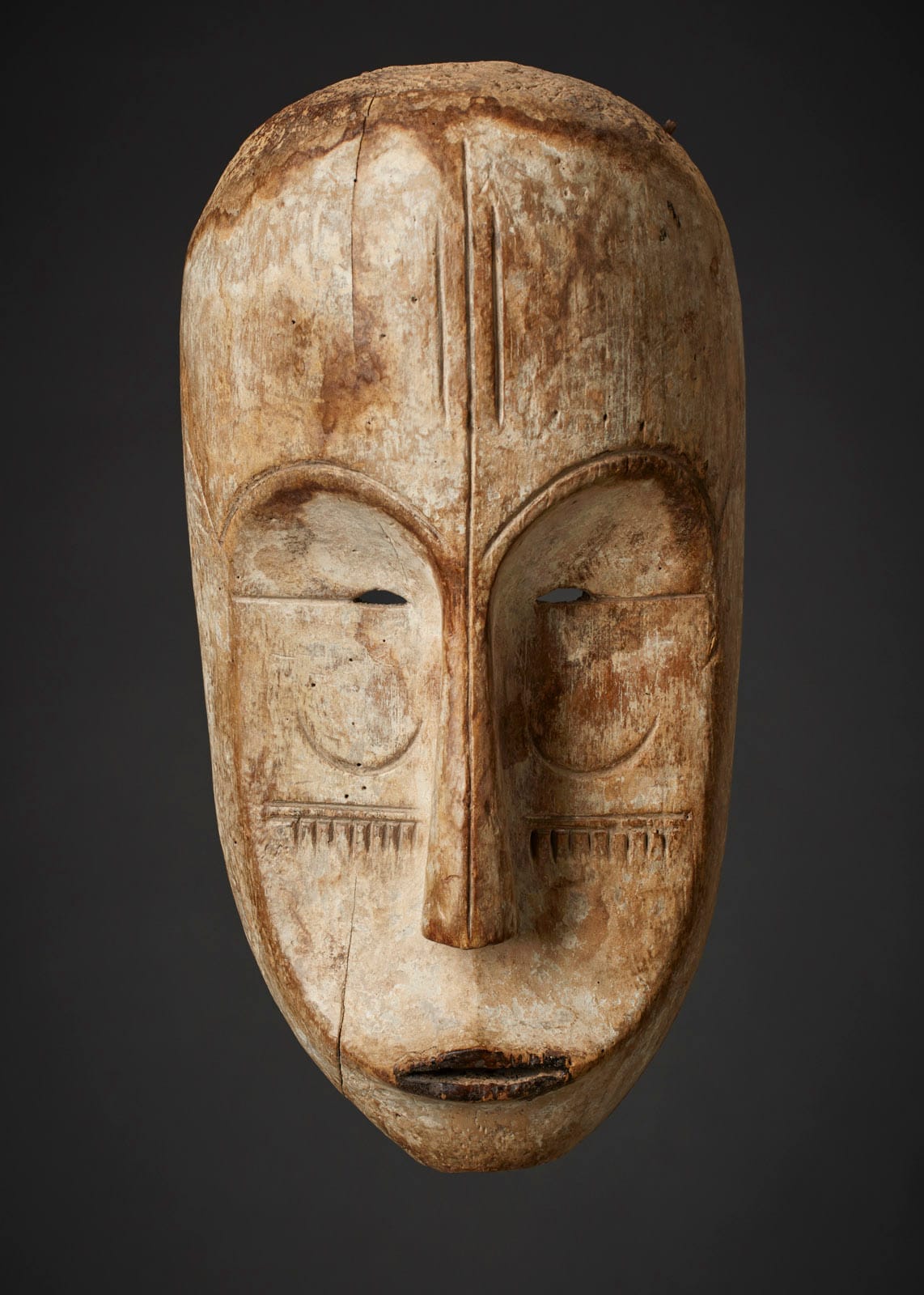
The Ngil mask has a long narrow face with an unusually broad forehead, an elongated chin, long and narrow nose, and a small and protruding mouth. Its whole surface is coated in pale white kaolin clay, which gives it a striking appearance especially when firelight catches it in the dark, making it look less like a man.
That was the point. Among the Fang of Gabon, Equatorial Guinea, and southern Cameroon, the Ngil society was the institution that handled what could not be handled in daylight. These included disputes between clans, witchcraft accusations, theft, debt, betrayal, and suspected sorcery. When a village could not resolve a problem through ordinary means, the elders called for the Ngil. The masked figures arrived at night, by torchlight, with a deep voice and a slow walk, and the village watched as judgment moved through it. The white kaolin signified the spirits of the ancestors and the clarity of vision the spirit was said to bring.
Initiation into the Ngil society was demanding. Candidates underwent purification, confession, an ordeal involving ants, and the presentation of ancestral relics. Only initiated men could wear the mask. The society held authority within Fang communities, and its name means gorilla, an animal whose presence in the forest commanded fear.
The Ngil society was suppressed in the early twentieth century, and the active tradition declined sharply afterwards. But the masks themselves remain among the most formally extraordinary objects ever produced in Central Africa.
5. Gelede — Yoruba, Nigeria, Benin, Togo
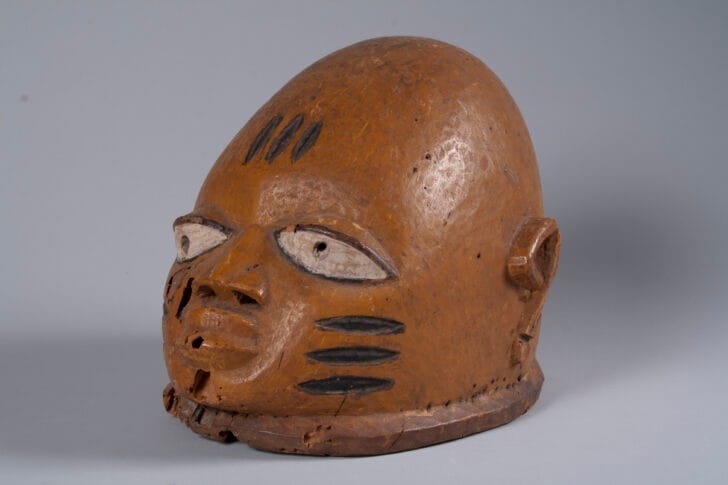
Gelede is the masquerade the Yoruba perform in honor of awon iya wa, "our mothers". This is a category that includes not only living elderly women, but also female ancestors and the goddesses themselves, understood as a single immense spiritual force. The Yoruba understand this force to be what holds the world together, supporting fertility, harvests, rain, the success of the marketplace, and the peace of the household.
The Gelede headdress is a carved wooden face, often topped by an elaborate superstructure. These structures often show scenes from everyday life such as a market scene, a pair of birds, a mother carrying a child, an equestrian warrior, or a satirical tableau commenting on village life. The masks are danced by men, but the women lead. Gelede is the only Yoruba masquerade tradition known to be governed by female officials. UNESCO has recognised it as a living heritage of the Yoruba-Nago people, performed across Nigeria, Benin, and Togo.
The performance unfolds in two phases. The night masquerade, called Efe, uses song and satire to comment on social behaviour including criticizing corrupt officials, and praising good behaviour. By dawn, the daytime Gelede begins, and the dancing is what dominates, with the dancers in lavish costumes moving in pairs while drums lead the rhythm, and the carved headdresses rise and fall with the movement.
What Gelede makes visible is the Yoruba understanding that the spiritual power of women is real, and that it shapes community life in both positive and negative ways.
6. Lipiko — Makonde, Tanzania and Mozambique
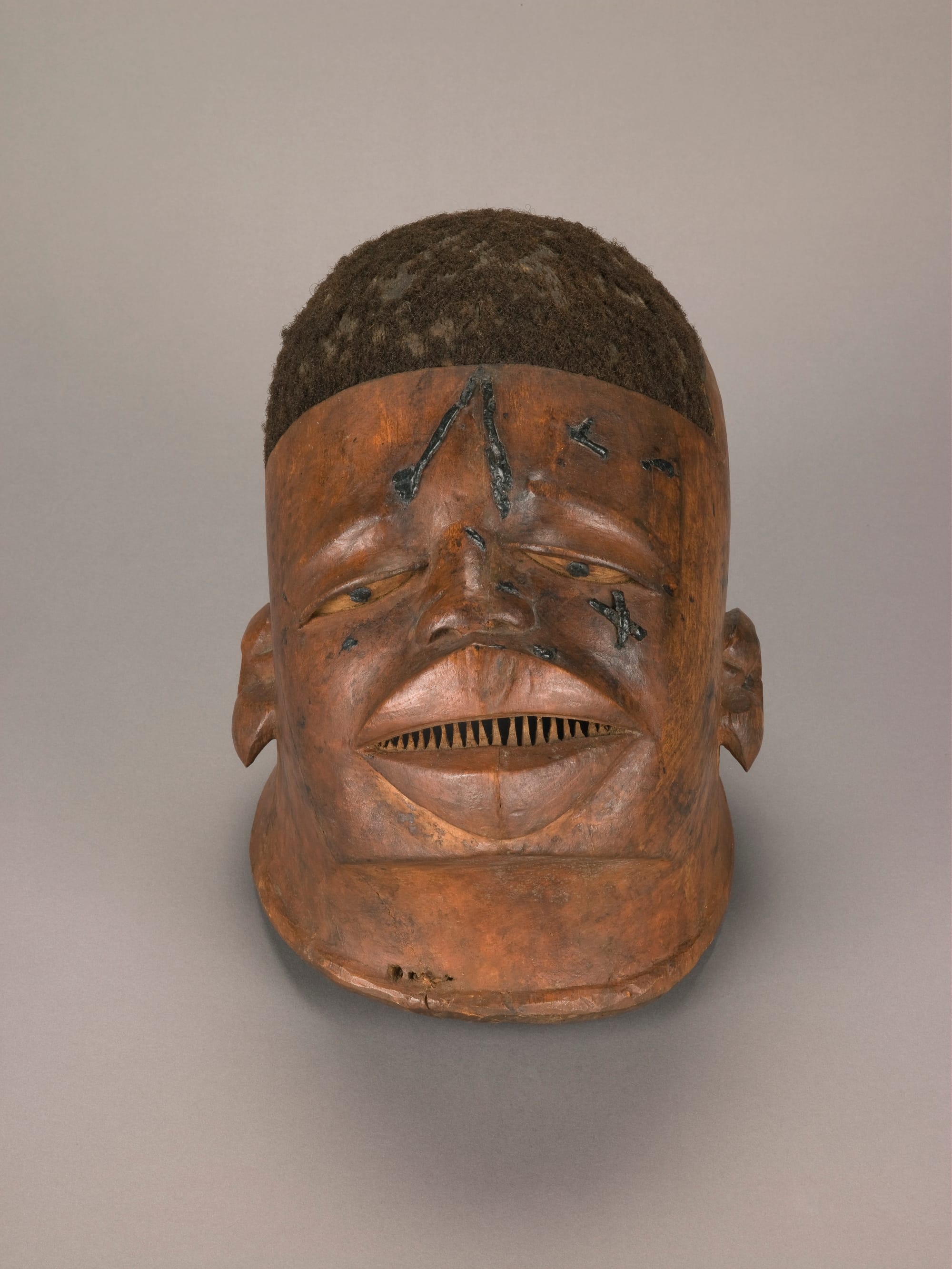
Far to the east, on the high Makonde plateau that straddles the Rovuma River between Tanzania and northern Mozambique, the masks look different. The Makonde carve some of the most realistic faces in African sculpture. A Lipiko mask has a real human nose, and real eyes and lips. Some are finished with real human hair fixed with beeswax. Some have carved scarification marks on the cheeks, copying the actual scarification of Makonde adults. From a few feet away, a good Lipiko looks like a person.
This realism is intentional. The Makonde are a matrilineal people, meaning clan membership and ancestry pass through the female line. In their origin story, the first man carved a woman from wood and brought her to life, and she became the mother of the Makonde. The Lipiko mask is the ancestor returning. When a young person completes their initiation into adulthood, the mapiko dance is held in their honour, and the ancestors come back masked to celebrate. They look as the Makonde themselves look, because they are the Makonde, symbolising the ancestors who have come home to witness their descendants becoming adults.
Lipiko is a helmet mask, carved from a single piece of soft kapok-like wood. It is worn over the entire head, tilted slightly back so the dancer can see out through the open mouth. The body is covered in cloth and a costume that, in some performances, includes a separate full body mask carved to depict a pregnant woman, which is the figure of fertility.
During such dances, the male dancer dramatises the agonies and triumph of childbirth. As the initiate becomes an adult, the ancestor becomes present. For the Makonde, these two things have always happened at the same time.
Masks in modern day African life
There is a temptation, when writing about African traditional art, to use the past tense. The temptation should be resisted. Dama ceremonies still happen on the Bandiagara cliffs. Sande initiations still happen in Sierra Leone and Liberia. The Bambara still dance Chiwara in the planting and harvest seasons of southern Mali. Gelede still happens annually across Yorubaland. Mapiko still happens in Mozambique, with both old and newer masks.
The form is also changing. Contemporary African artists have moved the mask from the village square into galleries, biennales, and public exhibitions, not as an antiques on display, but as a living language to be spoken in the present tense.
One of the clearest examples is Romuald Hazoumè, born in Porto-Novo in 1962. Raised within Yoruba and catholic traditions and later steeped in the Vodun traditions of Benin, Hazoumè began making masks as a child for Kaléta, the December children's masquerade. In the mid-1980s he started using the discarded plastic jerry cans used to smuggle petrol between Nigeria and Benin, turning them into mask-portraits. He calls them masques-bidons. The Cans become faces, handles become noses, openings become mouths, and brushes and feathers become hair. Each one is a portrait of someone he has met or a typical person in Beninese society.
Hazoumè does not pretend his works are sacred objects. They are art objects, exhibited in galleries, and he is clear about the distinction. Even so, what he is doing is older than the gallery system. He is doing what every Yoruba carver before him did, taking the materials available in a given time and shaping them into forms that reflect the society around them. Using the gasoline cans is not random. They are the central physical object of an entire economy shaped by oil and extraction, and tied to fuel smuggled between Nigeria and Benin.
In a 2024 interview, Hazoumè put the position with unusual directness:
Today, our biggest problem as Africans is that we look at Europe, and we want to do what Europe does. But we can embrace our culture and be ourselves. When you talk about your own culture, you have a place in the world, which is not the case when you talk about someone else's culture. Today we have to look at home.
Other artists follow similar paths. Calixte Dakpogan, also from Benin, builds masks from car parts, mirrors, electronics, and hair clippers. These become assembled portraits of a society constantly metabolising what it imports. Dimitri Fagbohoun continues this conversation in his own practice. Across the African continent, sculptors, performers, and installation artists are working in the long lineage of African masking. Instead of copying older forms, they are using available materials to respond to their environment and social reality.
Contrary to the way many masks are now displayed as museum objects, they were originally created as working objects with active roles in ritual and community life. That work changes over time, as do the masks and the people who make them. Yet the basic idea of a carved face that becomes a doorway when the dancer puts it on, and a moment when the masker is no longer seen as just themselves is still there. It was here before colonialism, and it is still here now. It continues through the people who made it and continue to make it.


